

Seahorses’ are a unique species of fish which stem from the pipefish family. They are the only species where the males carry the eggs during reproduction, and their DNA has the highest rate of genetic mutations of any bony fish that has been studied. According to PBS, this is how seahorses’ genome has the opportunity to transform quickly which explains why they have diverged as far as they have from the traditional fishy form.
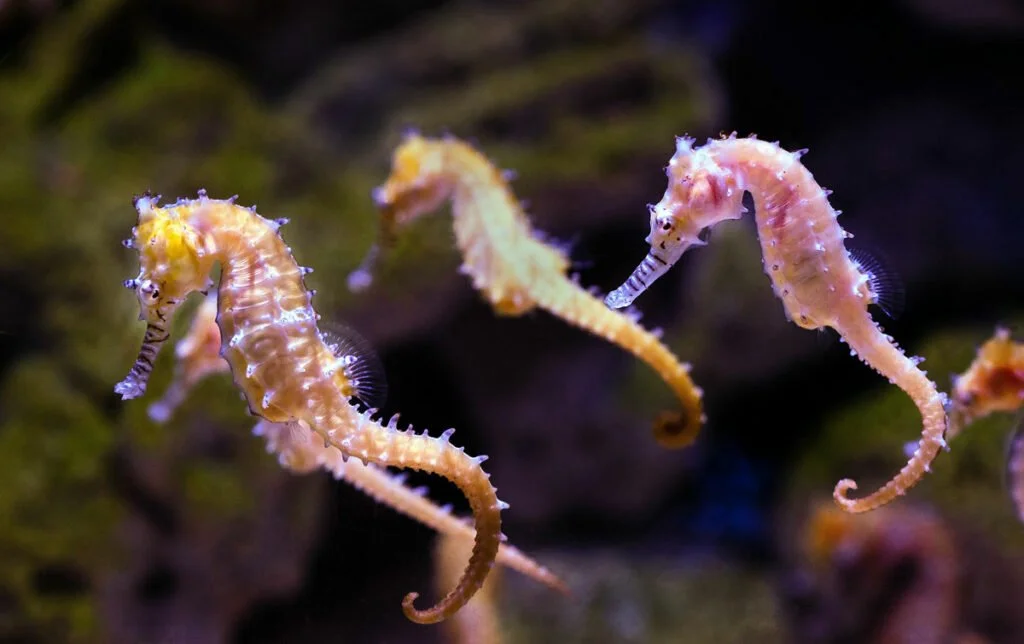
Seahorses are named for the shape of their head which is said to look like a tiny horse. They’re commonly found in the world’s tropical and temperate coastal waters: the West Atlantic and Indo-Pacific regions. They are the only fish to swim upright. Even though they’re fish, they aren’t strong swimmers and tend to move slowly through the water. They use their dorsal fins (back fins) to propel themselves slowly forward. To move up or down, they adjust the volume of air in their swim bladders, which is an air pocket inside their bodies.
Because of their inability to swim quickly, chasing their prey isn’t an option for them. Instead, seahorses lay in weight, stalking the eelgrass estuaries and using their camouflage adaptations to stay hidden, then, they ambush their next meal. These fish hunt by sucking water and their prey through their long snouts. Their mouths are small and toothless, so their main food sources are tiny crustaceans and plankton: fish larva or fish eggs. However, seahorses don’t have true stomachs, only a digestive tube, so they need to eat all day to get their nutrients.
Seahorses are typically found in seagrass beds, mangrove roots, and coral reefs. Some species, out of the 46 recognized species, live in estuaries as they are able to tolerate wide ranges in salinity. These fish aim to live in sheltered areas because of their difficulty in swimming and their adaptive ability of camouflage. Seahorses predators include crabs, sharks, skates, rays, and larger fish, so camouflage is incredibly important to their survival.
These fish also have prehensile tails that have evolved over time which are most commonly found in mammals. The tail is box shaped, rather than round, which allows it to make better surface contact with whatevers it’s gripping. Typically, seahorses hold onto coral heads, seagrass stems, sponges, mangroves, or other suitable objects when they need to anchor themselves. According to Scripps Institution of Oceanography, the square cross section also protects the tail from being crushed or pinched while the seahorse is being battered around by strong ocean currents.
As said before, seahorses are the only species where the males carry the young, called Fry, during reproduction. A female seahorse lays dozens, sometimes hundreds, of eggs in a pouch of a male seahorse's abdomen. The male then holds the eggs until it’s time for them to be released. Once born, the Fry, each about the size of a jellybean, find other baby seahorses and float together in small groups clinging to each other using their tails. Unlike other animal species, baby seahorses must find food and hide from predators as soon as they are born.
Seahorses are a complex species of fish derived from the pipefish family. These fish are known for their monogamy as they mate for life and live for 1-5 years. They have prehensile tails, poor swimming abilities, and the ability to camouflage themselves from possible dangers. They are the only species where the male carries the young and they have mutated far from the traditional fishy form (SeaLife).
Seahorses: The Mysterious Fish with a Twist
Madelyn Bird