
The Proud Family is an animated show about a 14-year-old Penny Proud and her family. The disney show was considered a jewel in the early 2000’s and was eventually given a reboot in 2022.
A majority of the characters and writers of the show are black or latinx. Despite this, the show, as well as its predescessor The Proud Family: Louder and Prouder, find themselves at the beating heart of a mass controversy involving race and representation. The original show was criticized many times for its skewed attempts at representing different cultures. In one such episode, which aired two years after the events of 9/11, Penny’s class is given an assignment which requires that they spend their week living with a family from a different background than their own. Penny ends up staying with the Zamins, a Pakistani Muslim American family.
In the short span of roughly twenty minutes, the episode is crammed with harmful Islamaphobic stereotypes and tropes. This is glaringly apparent in the portrayal of the father of the Zamin household as a raging sexist. The show even went as far as to depict a hate crime during the episode. And while all of this was purposeful in order to make Penny’s eventual moment of realization more impactful, it was largely unnecessary and more counterproductive than anything. It did more harm than good to an already marginalized group of people hurting for representation. According to the Pew Research Center, 60% of Muslim Americans consider the media coverage and representation to be negative. What the show did instead was to showcase how, as Aleshba Zahid put it, “Americans are more culturally ignorant compared to other countries”
The show also reinforced Asian, and more surprisingly, black stereotypes as well. In most media, this is common, and sadly, expected. But with so many black and brown creators working on the show, it’s just something that most wouldn’t have expected. If anything, one would think these people would be the most aware of, and sensitive to, the negative effects of these stereotypes, yet they remain littered throughout the show. Apart from the obvious and painfully overdone “sassy black girl” tropes that are seen througout the show in characters like Dijonay, the show also has the issue of favoring lighter skinned characters.
Just look at Penny’s parents Oscar and Trudy. They’re both black, but one wouldn’t know it just by looking at them. Penny’s mother is extremely fair skinned, so much so that people often mistake her for being mixed or all together not black at all. She is the reasanable one, the breadwinner, and the attractive one. While her husband, Oscar, who has a much darker skin tone is made to be the butt of all jokes and is not taken seriously by his family. This has been a recurrent theme in the show where lighter skinned black characters are given more positive traits and the darker ones are portrayed as being less desirable.
Another instance would be the case of the Gross Sisters. Unlike cartoons such as Doug and Big City Greens, the Proud Family did not have characters with wacky skin colors. Every Proud family character had natural skin whether it be black, beige, brown or olive, all except one sibling trio who stood out, as they sported a deep blue color. So the question is why blue?
The reason for their blue hue is supposedly due to being ashy and unable to afford lotion. Even with this explanation though, it is speculated that their coloring is an indirect nod to the colorist concept of being “Blue Black.” These characters are essentially the big bad bullies of the show. They are obnoxious, thuggish, and aggressive. The show goes seemingly out of its way to other these girls and make them appear savage-like with multiple of their appearances including animal growling and snarling. All things considered, it becomes a little hard to believe it’s a coincidence that these characters with traditionally afrocentric features have been depicted in such a way in comparison to the way that other characters with more eurocentric ones are.
Now that the reboot is here, the show is still working to become more inclusive and better representative of its audience. Their efforts are being met with mixed reactions. The biggest source of the division is the episode “Juneteenth”. In the episode, Penny and her friends learn the meaning of Juneteenth and discover that their town was founded by a slave owner, and built by slaves. In a presentation for school, the students perform a rap about their history and how as the descendents of slaves they have earned reperations for the suffering of their ancestors as promised by the goverment, their 40 acres and a mule. The children credit abolitionists such as Harritet Tubman, Nat Turner, and Fredrick Douglas for the end of slavery as opposed to Abraham Lincoln who is often credited by the general public.
The episode was slammed and labeled as “blatant anti-white propaganda” and accused of “beaming woke BLM” notions into homes. Another scene from later in the same episode shows the students staging a peaceful protest as police in riot gear standoff with the children which enraged certain viewers even more and spurred a wave of #BoycottDisney posts.
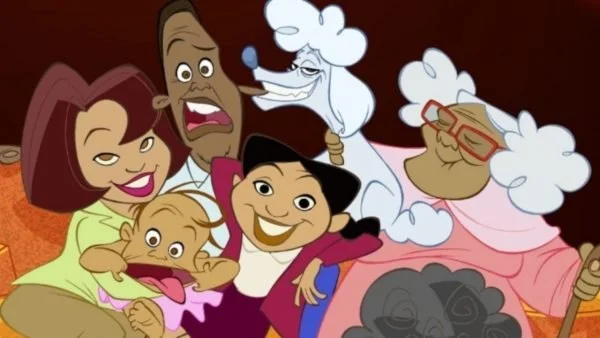
Disney's Proud Family Reboot Sparks Outrage Over Racial Stereotypes and Representation
Lily English